
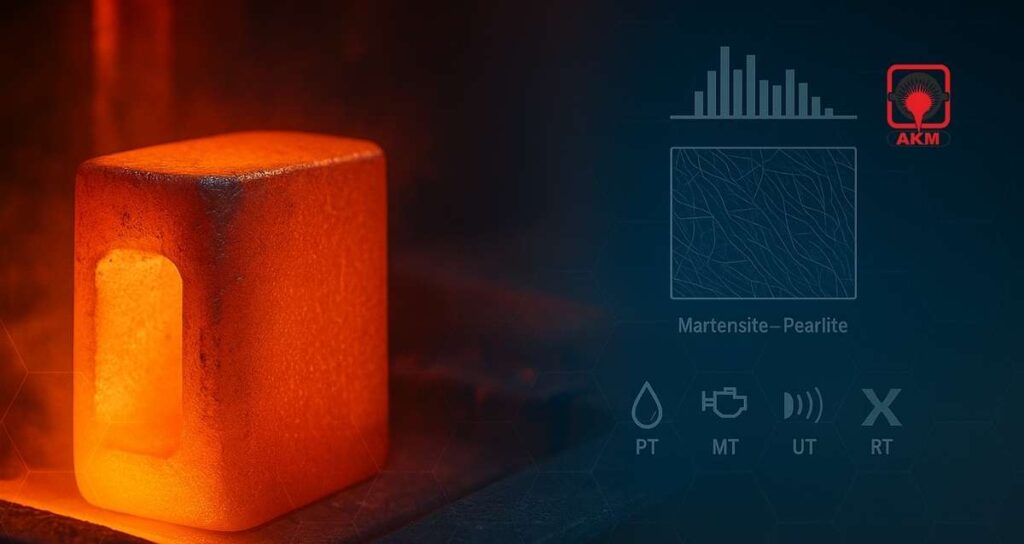
The Strategic Importance of Steel Casting in the Defense Industry and Heavy Machinery Manufacturing; The two most demanding arenas of modern industry, defense and heavy machinery manufacturing, share one common denominator: zero tolerance for failure. From the track links of a tank to the bucket attachment of an excavator, every single component used in these sectors must demonstrate absolute reliability and superior performance under the most extreme conditions. At this juncture, material selection is not just an engineering decision; it is a strategic imperative. As Ahkemak Metalurji, a leader specializing in the casting sector since 1973, we are taking a detailed look at why steel casting is the indispensable material for these demanding applications and how it differs from other casting types.
The Uncompromising Demands of Demanding Sectors
Heavy machinery and defense equipment are subjected to sudden impacts, extreme loads, severe abrasion, and fluctuating temperatures. When a construction machine is lifting tons of rock or an armored vehicle is facing ballistic threats, the mechanical properties of the material are of vital importance.
The core requirements for these sectors include:
- High Strength and Toughness: The material must possess both high tensile strength and a non-brittle nature (toughness).
- Impact Resistance: Resistance to sudden shocks and impacts is critical, especially in the defense industry.
- Wear Resistance: Durability is essential for parts subject to constant friction (e.g., tracks, gears).
- Weldability: The ability to weld the material is crucial for fabricating complex structures and enabling in-field repairs.
Why Steel Casting Stands Out
Steel casting is a unique engineering material capable of meeting all these demanding requirements. The primary difference that sets it apart from cast irons is its chemical composition and the resulting superior mechanical properties.
- Superior Mechanical Properties: Steel casting boasts significantly higher tensile and yield strength compared to other cast types. This means components can withstand greater loads without bending or fracturing.
- Impact and Shock Resistance: The toughness (impact energy absorption capacity) of steel casting, especially in low-carbon and alloyed grades, is exponentially higher than that of cast irons. This makes it ideal for armored vehicle components and crusher/excavator parts.
- Design and Alloy Flexibility: Steel casting allows for customized properties through alloying with elements like nickel, chromium, and molybdenum. It is possible to produce steels that are high-temperature resistant, corrosion-resistant, or ultra-hard for wear resistance.
- Excellent Weldability: Whereas other cast irons (especially gray cast iron) are very difficult to weld, steel casting parts are readily weldable. This simplifies the manufacture of larger, more complex structural components.
Why Other Castings Fall Short: Gray vs. Ductile Iron Casting
At Ahkemak Metallurgy, we produce a wide spectrum of materials, including Gray Cast Iron (Pik Döküm) and Ductile Iron Casting (Sfero Döküm). Every material has its purpose, but the differences become stark when defense and heavy industry are involved.
- Gray Cast Iron: This material has excellent vibration damping capacity and machinability. This makes it wonderful for machine bases or engine blocks. However, due to the lamellar graphite in its structure, it is brittle and has very low impact resistance. It is not suitable for high-load or shock applications.
- Ductile Iron Casting: Ductile iron has far superior mechanical properties to gray iron. Because its graphite structure is spherical (nodular), it is more ductile (flexible) and more resistant to impact. It is excellent for pipelines, valves, and some automotive parts. However, it still cannot achieve the ultimate toughness, weldability, and alloying flexibility offered by steel casting.
In short, gray cast iron may be sufficient for a machine base that needs to absorb vibration, and ductile iron may be fine for a standard gear. But when it comes to the tooth of an excavator that shatters rock or a suspension component on a tank, the only reliable choice is steel casting.
The Reliable Solution Partner: The Ahkemak Metallurgy Difference
Manufacturing parts for the defense and heavy machinery industries is not merely about melting and pouring metal; it is a process of precision and reliability. At Ahkemak Metalurji, we combine our deep-rooted experience from 1973 with the technological capabilities of our 4000 m² modern facility in Konya.
Our production processes are designed to meet the expectations of these critical sectors:
- Detailed Quality Control: We apply spectrometer analysis, hardness testing, and non-destructive testing (NDT) methods at every stage, from raw material input to the final product.
- Advanced Technology: Our high-tech induction furnaces and heat treatment ovens unlock the full potential of steel casting.
- Expert Engineering: With an experienced engineering team that knows which alloy will perform best in which application, we are not just a parts supplier to our customers, but a complete solution partner.
In strategically vital sectors like defense and heavy machinery manufacturing, material selection directly dictates performance. Steel casting, with the strength, toughness, and design flexibility it offers, is the indispensable material for these fields. Ahkemak Metalurji, with its half-century of expertise, continues to provide the most durable steel, ductile, and gray cast iron solutions for your most challenging projects.
You can find our contact address via the link.
For more content, please visit our News page.

