
High Quality in Steel Casting: Strong Designs and Expert Production Tips
In the most demanding fields of modern industry, such as defense, heavy machinery manufacturing, and the energy sectors, the failure tolerance of components used is nearly zero. When material selection is considered in these critical areas, steel casting stands out as an indispensable solution due to its unique mechanical properties and design flexibility. However, not every casting offers the same performance.
Achieving high quality in the steel casting process is not just about melting metal and pouring it into a mold. It is an integrated chain of engineering and expertise stretching from the design desk to the final quality control. As Ahkemak Metallurgy, with experience gained since 1973, we detail the tips for obtaining quality steel casting and the impact of strong designs on production in this article.
The Basis of Quality: Strong Design for Casting
A perfect steel casting part does not begin in the foundry, but in the design office. It is not enough for a part to be designed merely functionally; it must also be designed to be “castable.” Designs that contradict casting principles invite quality issues like porosity (gas voids), shrinkage, or cracks during production.
Points to consider for a strong casting design:
- Avoiding Sharp Corners: Sharp internal and external corners lead to stress accumulation and cracks during cooling. Smooth transitions (fillets) improve casting quality.
- Wall Thickness Balance: Sudden changes in wall thickness cause different cooling rates, creating shrinkage voids. As homogeneous a wall thickness as possible is vital for steel casting parts.
- Simulation Support: As Ahkemak Metallurgy, we analyze the flow and solidification of metal inside the mold in a virtual environment using casting simulation programs during the design phase, eliminating potential defects before production.
Critical Stages of the Expert Production Process
After the design is verified, the production part requiring expertise begins. The steel casting process is an operation where every step requires precision. So, moving beyond the question of what is steel casting, which stages must be paid attention to for quality production?
Raw Material and Melting Control
Quality begins with the raw material entering the furnace. The selection of scrap and the purity of alloying elements directly affect the chemical composition of the final product. The temperature and chemical analysis of the metal melted in our modern induction furnaces are instantaneously controlled with spectrometer devices. This guarantees that the steel casting material fully complies with the desired standards (ASTM, DIN, EN).
Molding and Casting Precision
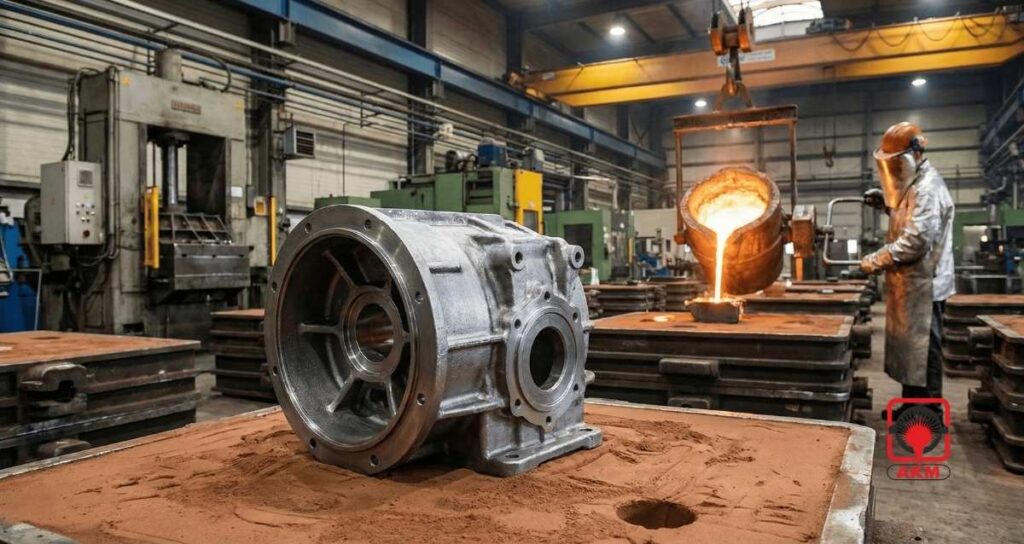
The mold is the negative of the casting. The sand, hardness, and gas permeability of the mold determine the surface quality and dimensional tolerances. Our expert team designs the most suitable gating and feeding systems for the part’s geometry, ensuring the metal fills the mold turbulently-free and completely. This precision is one of the elements that creates the difference between quality steel casting and ordinary casting.
Boosting Performance with Heat Treatment
Many think casting is finished once it leaves the mold, but for steel casting, the real process of characterization begins with heat treatment. In its “as-cast” state, steel is generally coarse-grained and has internal stresses. Heat treatment processes like normalization, tempering, or quenching refine the internal structure of the material, allowing it to reach the desired hardness, toughness, and strength values.
Why Ahkemak Metallurgy?
Although there are many steel casting companies in Turkey and globally, what makes Ahkemak Metallurgy preferred for the most challenging projects is our mastery of all the processes mentioned above.
In our 4000 m² modern facility in Konya, we do not just manufacture; we also implement a detailed quality control process. We verify the internal and surface quality of the steel casting parts we produce using Non-Destructive Testing (NDT) methods (ultrasonic, magnetic particle, and liquid penetrant).
The advantages of steel casting include high strength and design flexibility; however, these advantages only become reality in expert hands. As Ahkemak Metallurgy, with our half-century of experience, we are your reliable solutions partner in projects aiming for high quality from design to final product.
You can find our contact address via the link.
For more content, please visit our News page.

