
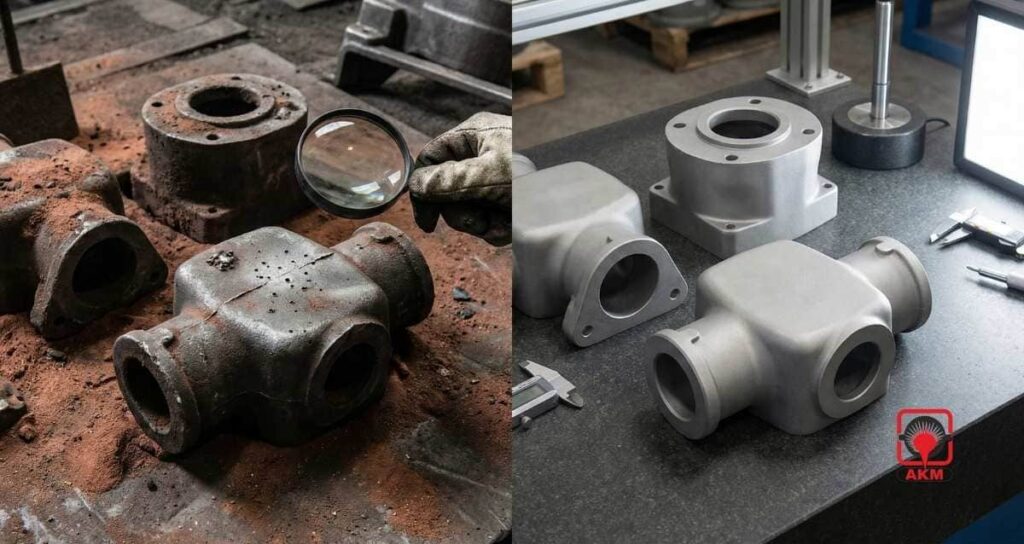
Casting Surface Defects and Remediation Methods: An Expert Guide to Flawless Parts
In the casting industry, the quality of the final product is measured not only by the integrity of its internal structure but also by its surface quality. Especially in critical sectors such as defense, automotive, and precision machinery manufacturing, surface flaws in casting parts are unacceptable. As Ahkemak Metallurgy, with deep-rooted experience in steel casting, ductile iron casting, and gray iron casting since 1973, we know the engineering behind flawless surface quality.
In this article, we will examine the most common surface defects encountered in foundries, their root causes, and the professional methods applied to remedy these defects.
Why Is Casting Surface Quality Critical?
The surface quality of a casting part is not just an aesthetic concern. Surface defects can reduce the fatigue resistance of the part, increase machining costs, prevent proper adhesion of paint or coatings, and, most importantly, lead to incompatibility during the assembly phase.
While surface reactions are more intense in steel casting parts poured at high temperatures, metal-mold interactions in ferrous castings such as ductile iron casting and gray iron casting can lead to different surface problems.
Most Common Casting Surface Defects, Causes, and Solutions
Casting surface defects usually stem from the interaction of the molten metal with the mold sand, casting temperature, or gating system design. Here are the most common ones:
1. Sand Burn-on and Fusion
This is one of the most common and hardest-to-clean surface defects. It occurs when molten metal penetrates between the mold sand grains or fuses the sand grains onto the part surface. The part surface takes on a rough, sandpaper-like texture.
- Causes: Excessive casting temperature (especially critical for steel casting), low refractory (heat resistance) properties of the mold sand, or insufficient mold compaction.
- Remediation Methods: Casting temperature must be kept at an optimal level. High-quality, heat-resistant casting washes (coatings) should be applied to the mold surface to sever metal-sand contact. At Ahkemak, we use special refractory coatings tailored to the type of alloy being poured.
2. Surface Pinholes
These are numerous small, pinhead-sized holes visible on or just below the part surface. They are usually spherical.
- Causes: Excessive moisture in the mold sand, cores not being dried properly, or high amounts of dissolved gas (hydrogen, nitrogen) within the liquid metal. This situation is frequently seen in both ductile iron casting and gray iron casting parts.
- Remediation Methods: Mold and core moisture content must be strictly controlled. Mold gas permeability should be increased. Effective degassing procedures should be applied during melting.
3. Cold Shuts and Laps
These are linear defects that occur when two different streams of metal flow fail to fuse completely while filling the mold. They look like cracks on the surface but usually have rounded edges.
- Causes: The metal cooling too early inside the mold due to very low casting temperature, slow pouring speed, or poorly designed gating systems.
- Remediation Methods: Casting temperature should be increased, and pouring speed optimized. Metal flow should be analyzed with simulation programs, and the gating system revised accordingly.
4. Run-outs and Fins
These are excess metal protrusions that do not belong to the part’s form, caused by liquid metal leaking from the mold parting lines or core prints and solidifying.
- Causes: Mold halves not mating perfectly, insufficient mold clamping force, or incorrect core tolerances.
- Remediation Methods: Mold maintenance and checks should be performed regularly, and it must be ensured that cores fit perfectly inside the mold.
The Ahkemak Metallurgy Approach: Preventive Quality
The lowest-cost way to remedy surface defects is not to create them at all. As Ahkemak Metallurgy, in our steel casting, ductile iron casting, and gray iron casting projects, we minimize surface defects through pre-casting simulations and strict process controls. Any inevitable minor surface roughness that may occur is removed through post-casting sandblasting, grinding, and special surface treatment techniques, delivering parts to the customer with excellent surface quality.
A quality casting surface is a combination of experience and technology. If you are experiencing surface quality problems in your projects, you can contact Ahkemak Metallurgy‘s expert staff.
You can find our contact address via the link.
For more content, please visit our News page.
Frequently Asked Questions (FAQ)
Why is sand burn-on (fusion) more common in steel casting parts?
Steel casting is performed at much higher temperatures (around 1600°C) compared to gray and ductile iron casting. This high temperature causes the mold sand to approach its melting point or allows the metal to penetrate between sand grains more easily, increasing the incidence of sand burn-on defects.
How can surface pinholes be prevented in ductile iron casting?
In ductile iron casting, gas evolution can be triggered during the magnesium treatment process. To prevent pinholes, the moisture content of the mold sand must be kept low, a good gas venting system must be provided, and the gas level of the molten metal must be kept under control.
Do casting surface defects always cause part rejection?
No. Some superficial defects (e.g., small fins or slight roughness) can be removed through post-casting “fettling” (cleaning) processes such as sandblasting or grinding, bringing the part within technical drawing tolerances. However, structural defects like cracks or cold shuts are usually grounds for rejection.

