
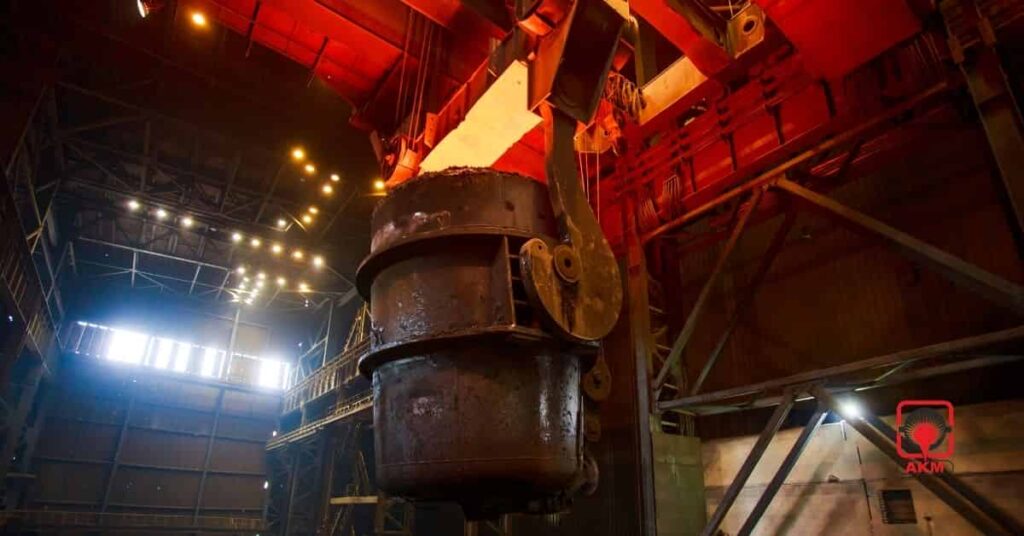
Steel casting, the backbone of industrial production, is an indispensable manufacturing method that combines strength, durability, and complex forms. From the defense industry to the automotive industry, from shipbuilding to heavy machinery, many critical sectors derive their strength and reliability from cast steel parts. So, what ensures these parts deliver the same quality, safety, and performance every time? The answer lies in internationally recognized steel casting standards. These standards serve as a roadmap for manufacturers and a quality assurance system for users.
In this article, we will begin by examining in detail the fundamental steel casting standards that guarantee quality and reliability in production processes, starting with what steel casting is.
What is Steel Casting and Why Is It So Important?
Steel casting, in its simplest form, is the process of pouring molten steel into a pre-prepared mold, solidifying it and taking the shape of the mold. This method allows for the one-time production of parts with complex geometries that would be difficult or impossible to produce using other methods, such as forging or machining.
The key advantages of steel casting are:
- Design Flexibility: Allows for the production of virtually any complex shape and size.
- Superior Mechanical Properties: Its high tensile strength, toughness, and impact resistance make it ideal for parts operating under heavy loads.
- Wide Range of Alloys: Various elements such as chromium, nickel, and molybdenum can be added to steel to achieve different mechanical and chemical properties (corrosion resistance, high-temperature resistance, etc.).
- Cost Efficiency: Provides an economical solution for complex parts, especially in mass production.
These advantages make steel casting indispensable in many industries. However, fully realizing this potential is only possible by strictly adhering to specific standards.
The Key to Quality in Production: Steel Casting Standards
Steel casting standards are technical documents that define a material’s chemical composition, mechanical properties (hardness, tensile strength, yield strength, etc.), casting tolerances, testing procedures, and quality control criteria. These standards ensure that cast parts produced around the world meet the same level of quality. The main international standard-setting organizations are:
- ASTM (American Society for Testing and Materials) Standards
Although based in North America, they are one of the most widely used standards globally. ASTM has published numerous standards focusing on material properties and test methods for steel castings. Some prominent standards include:
- ASTM A27/A27M: Standard specifications for carbon steel castings suitable for room-temperature use in general engineering applications.
- ASTM A148/A148M: Standards for steel castings for structural applications requiring high strength.
- ASTM A216/A216M: A critical standard for carbon steel castings used in pressure-bearing parts (valves, flanges, etc.) suitable for high-temperature service.
- EN (European Norms) Standards
These standards are valid in European Union countries and are increasingly becoming a global reference. Türkiye has also largely harmonized its standards with EN norms.
- EN 10293: Covers steel castings for general engineering uses.
- EN 10213: Contains technical delivery conditions for steel castings to be used in pressure vessels and equipment.
- DIN (Deutsches Institut für Normung) Standards
DIN, the German Industrial Standards, has a long history and high reputation, particularly in the machinery manufacturing and automotive sectors. DIN standards form the basis of many EN standards. - ISO (International Organization for Standardization) Standards
Bringing together national standards organizations from over 160 countries, ISO develops international standards to facilitate global trade. Specifically for steel castings, it focuses on quality management systems and general technical rules rather than material standards.
- ISO 9001: This is a quality management system standard that demonstrates an organization’s ability to consistently deliver products that meet customer and legal requirements.
- ISO 8062: This is a fundamental standard that specifies dimensional and geometric tolerances for castings.
These standards provide a common language for all processes from the ordering of a casting to its delivery. When a customer specifies the desired material properties using a standard code, the manufacturer knows exactly what chemical composition, mechanical properties, and tolerances a part should be produced with.
A Standard-Guiding Approach with Half a Century of Expertise
Ahkemak Metalurji, which has combined its deep-rooted experience in the casting industry with modern technology since 1973, bases its production processes on these international standards at every stage. Founded in Konya in 2008 by Mehmet Ali Küçük, it currently operates from its modern 4,000 m² facility.
You can find our contact address via the link.
For more content, please visit our News page.

